Everybody Loves Christopher Nolan
Including me. Even though I think he's a little stupid.


Christoper Nolan loves topic sentences. He loves the idea of things, the concept of things, of starting a bunch of ideas that don’t immediately cohere, distracting you with loud noises and spectacular visuals, and then tricking you into thinking he’s wise. The Dark Knight, a movie I loved at sixteen but discovered is incredibly stupid at twenty-six, is the most obvious perpetrator of this. Batman, the Joker, Harvey Dent, Alfred, Rachel, etc. all speak in topic sentences. They are not human beings talking to each other; Nolan isn’t really interested in those. He is interested in problem-solving, time, and the idea of getting home (see: Inception, Interstellar, Dunkirk, The Odyssey).
A tenet (yes, I did that on purpose) of screenwriting is to state your theme on page three. It doesn’t literally have to be on page three but the idea is to state up front what your movie is about. If you don’t do this, you end up with unwieldy student films, bad television, or worst of all: avant garde foreign films (French). Even bad movies abide by this rule because at the very least, your audience will feel attached enough to see the rest of it through, that is, if the theme you’ve stated is compelling in one way or another. Almost always, the protagonist will, in a line or two, indirectly tell you what the movie is going to be focused on. Sometimes it comes in the form of a character that means a great deal to the protagonist asking them a question which they will reflect on throughout the course of the story. The best movies do this in subtle, natural, surprising ways that stick with you throughout the duration of the runtime.
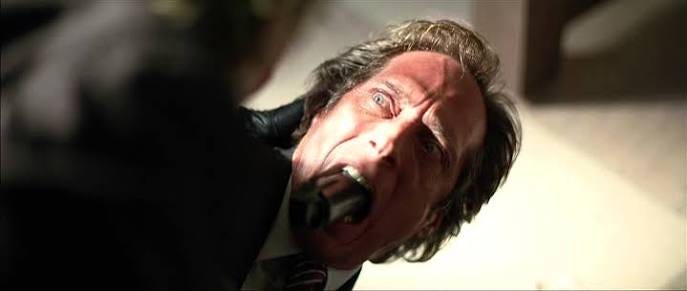
In the opening scene of The Dark Knight, before putting a grenade in William Fichtner’s mouth, the Joker replies to his panicked observation that criminals in Gotham don’t believe in anything anymore that: “Whatever doesn’t kill you, makes you stranger.” This guy’s nuts! I know what this movie is about. Batman, a rule follower, will face a psychopath who has no goals or rules. Unstoppable force, immovable object. Great. In Inception, DiCaprio explains how an idea is like a virus that can be planted, most easily in dreams. I know what this movie’s about. In Interstellar, little Murph (yes, I was named after this character) comes in talking about ghosts and then old Murph starts talking about the dust. I don’t quite know what this movie’s about yet, but that’s only because it has a twist waiting. But when you know the twist, it’s easy to look back and understand.
All that is to say, I just watched The Odyssey for three hours and I have no idea what it’s about. I say this as someone who is pretty good at movies, has seen all of Nolan’s other works more than once, and as a Bachelor of Arts, specifically as it pertains to the English language. And no, “going home” isn’t an answer. That might describe the protagonist’s (what was his name, again?) desire, but it doesn’t tell me what the movie’s about. It’s also hard to discern because, much like Oppenheimer, the first hour of this movie is edited for people who have zero attention span. Any time there is expositional dialogue, and there is a ton of it in the first act, you are bum-rushed with information and it is cut so quickly in a way that communicates that Nolan is boring himself and he doesn’t want to bore you too. He just wants to get to the adventures which he (and Jennifer Lame, queen) do not cut like that; when there’s a big, scary monster, you are going to see every beat of that. When Telomachus is talking to Antionoious or Eumanenanueuus, I don’t know what’s going on. And if I was 12 or a normie, as is the target audience for this wildly popular movie, I would fall for the trap of, “wow these famous people are adapting this really old important thing and because I don’t understand it, that’s an indication that it’s smarter than me, and I should be in awe of that.” When in reality, I’m starting to think that Nolan is the dumb one.

Let’s test some theories of what this movie is about. Thankfully, the whole thing has been leaked already so I can go back and cite specific examples that I’m not able to remember from a few hours ago because all the topic sentences were so vague and confusing. Okay, what does the movie open with? Oh, right. Travis Scott. A man, a thought (?), a trick, etc. So that’s not it. Is it in the leaden exposition dump exchange between Hathaway Holland & Pattinson (a hypothetical law firm I would trust)? Where we hear for the first of what will be hundreds of times that 1) Odysseus is gone 2) He may or may not be dead and 3) Penelope has to choose a new husband because they can’t be without a king? No, that’s just more plot. Is it about “Zeus’ Law”? Reduced to treating others as you would want to be treated because they could be gods in disguise? They sure bring it up a lot so I guess it’s a recurring theme because Robert Pattinson is mean and should treat people better? (Reminds me that Ted Lasso is coming back, which means my death is approaching). Oh maybe it comes from the later sword-fighting exercise where we learn that you should let enemies think you’re making a mistake first and draw the attack. I guess that’s a setup that pays off later. Still not a theme.
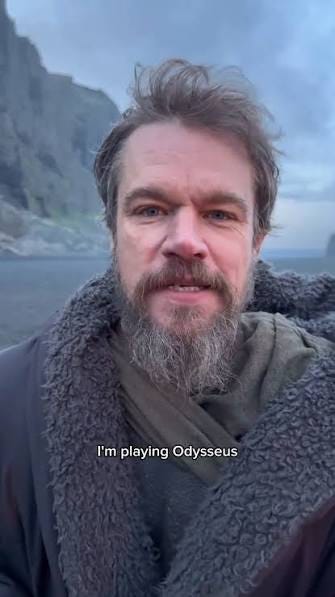
This is a movie that’s about stuff that happens and not much else. It’s about plot with some modern anxieties pasted on top. There’s no thesis, no core, no through-line. It’s also not as if it has so much on its mind and can’t settle on one idea. There are no ideas. There are hardly characters. There are plot beats, action, and setups and payoffs, all strung together and buried (my least favorite part of Inception was how Ellen Page’s Canadian ass pronounces “buried” and it’s insane to me that he had Elliott Page say it again in this) in flat, weightless dialogue.
If your movie isn’t really about anything, it then has to rely on either spectacle or style. This movie has spectacle and, I would argue, a muted, dull style. The below-the-line stuff like the effects and production design and costuming and sometimes the editing are all strong. The score…maybe. But as I often point out, what’s the point of something being well-lit with great sound if it’s in service of nothing? I guess some people still like just watching fireworks. To me, it’s just a set of really well-assembled keys that are jangling in front of my face, still. And I don’t even mind that it’s popular. Spectacle and adventure have always been popular, for good reason. I also don’t care about whether it’s a faithful adaptation or not. I have no idea if it is; that’s completely irrelevant to whether it’s an interesting movie or not. My issue is with the 20-something guys coming out of this hailing it as some thoughtful, moving masterpiece when really they just like that it feels epic, well-crafted, and serious. Or as I heard a few guys after my screening describe it: “Crazy!!!” There is absolutely nothing crazy about this movie.

Similarly, and please don’t take offense to this as I consider myself as a fan of both Nolan and Taylor Swift, but in this way, Nolan has really become Taylor Swift for boys. For years during peak Eras Tour mania, people have been asking who Taylor Swift for boys is and we finally have an answer. Largely, Swifities aren’t Swifities because they have some grand appreciation for craft or music: they’re Swifties because the content feels relatable and true and it’s expressed in a slightly more articulate way than they could ever manage. And, throwing my hands up, there is nothing wrong with that. The same is true for Nolan, who makes movies for serious boys who see maybe 6 movies a year. What I mean by this is that they both have become the digestible, universally-agreed upon media object that everyone will at least admit is good, while most people would argue is great. Their unveilings have become events, released in multiple formats, and you are meant to add them to a head-canon catalogue for later comparison. Neither product has much individuality, but both have enough qualities that are universal and undeniably impressive. They have different eras and looks and subject matters but none are ever really rising above middlebrow for the most part. There are, of course, exceptions like Inception and folklore and Dunkirk and 1989, but especially lately, the products are things everybody is aware of and that are, at the end of the day, sanctioned by the monoculture. It’s not much of a leap to assess that the average 20-something male is fascinated by the same type of thing that the average 20-something female is fascinated by (at least proportionately) and that both are pretty annoying.
Me when he shoots the arrow through the axes.
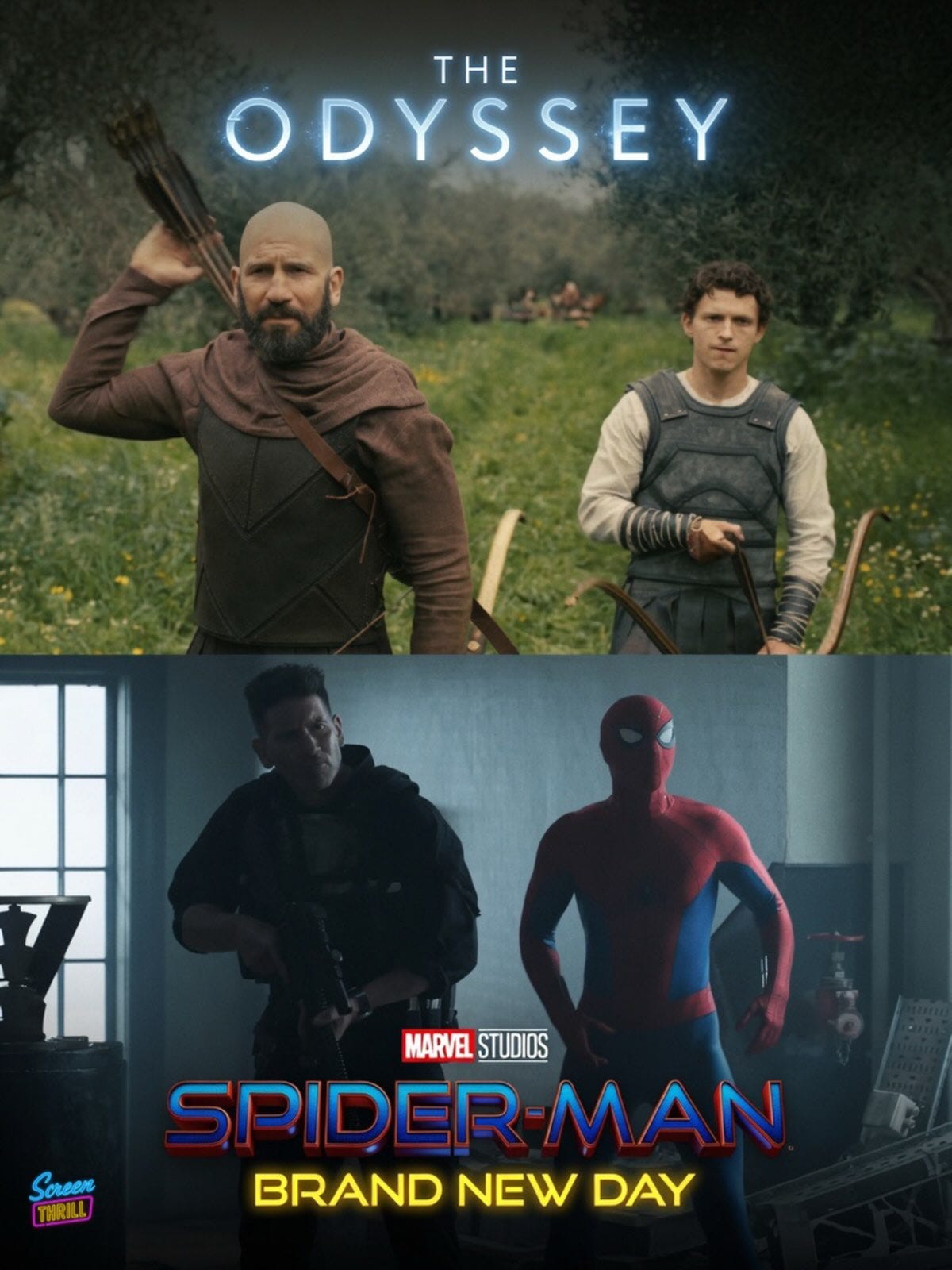
But aside from the masses, a few people I respect have argued that this film’s central concern is similar to Oppenheimer’s: that one man reels from the consequences of how he has changed the world for the worse and his responsibility in that. That’s an interesting observation, given that Odysseus’ leading of the men in the Trojan War did lead to a betrayal of the laws they all held to be sacred and now nothing will be the same again. He feels immense guilt over this (a thoroughly anachronistic response, by the way) and it leads to the death of his men and distrust among the nearby communities from then on (I’m assuming. This is never shown or really discussed). But is that what the movie is about? When we’re fighting with the cyclops or the tentacle-y things outside the abyss or when Spider-Man is shooting arrows with the Punisher? Are those scenes in conversation with that idea? No, how can they be? It’s not something that’s introduced as a conflict until the third act.
The first major resolution of getting home comes by Odysseus surrendering his force of will and by giving in to fate. He is advised to do this via perfume commercial voiceover from Charlize Theron’s character who is as neutral and deadpan as everyone else in this movie (other than Pattinson, Morton, or Bernthal). If the central conflict is about his responsibility in all this suffering due to his actions, the movie offers that the solution is to just let go and let the gods determine your fate. The gods who have been punishing you the whole movie, for multiple decades. Okay, so just renounce yourself and let the gods handle it. Maybe that’s what the movie is about. Throw down your pride and trust in “fate” or whatever. That’s why he returns as a beggar. But…fate and the gods don’t kill all the suitors with spears and swords and bows and arrows (freaking epic, by the way). Odysseus does. He does it with his signature strength and skills. Are the gods rewarding his humility? By allowing him to murder his enemies? I don’t know and it doesn’t matter because the sound he makes with the bow after he strings it is cool.
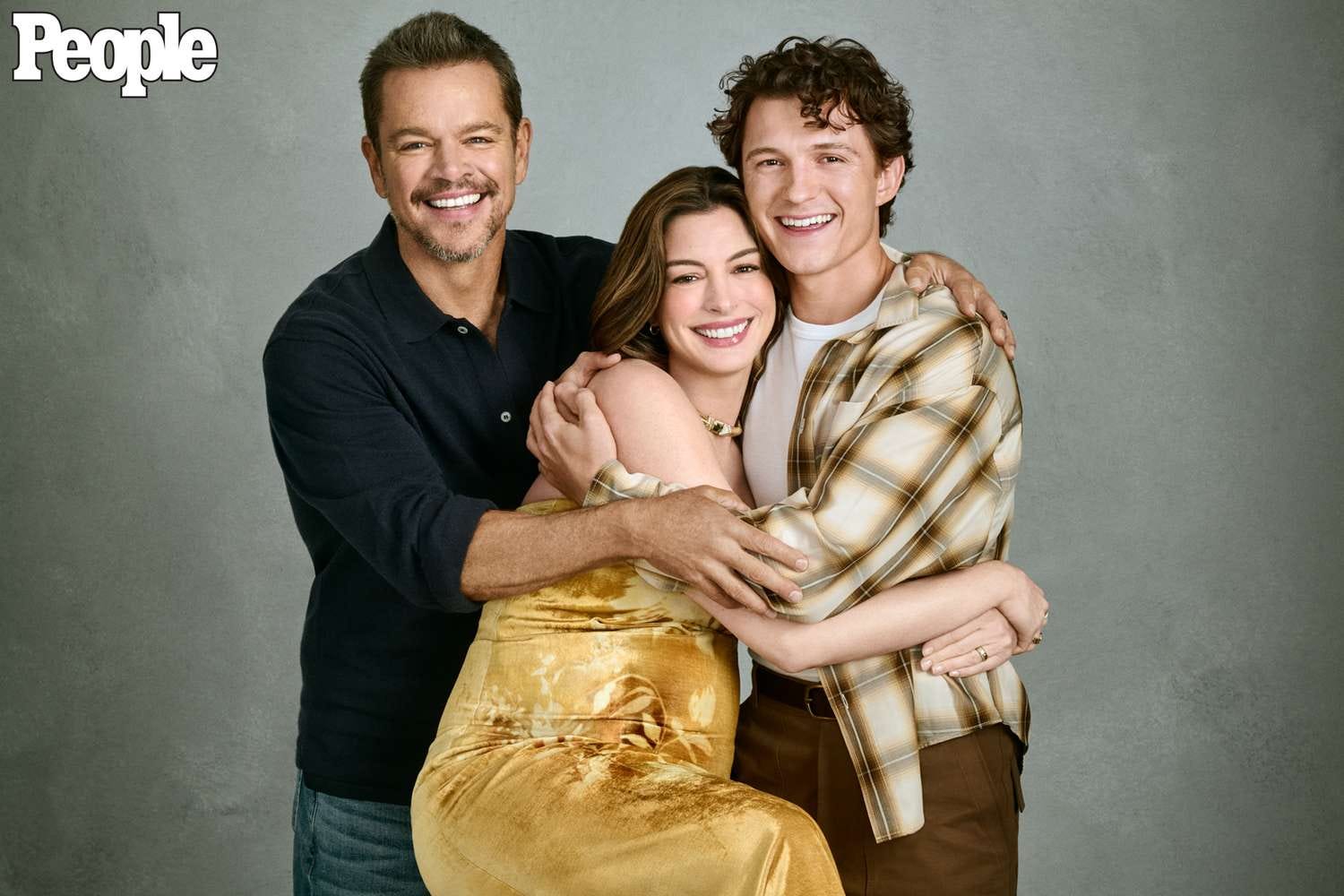
Finally, if the beginning and middle of the movie doesn’t give us an answer, surely the powerful final exchange between our lead characters will:
“Why will the stories only be sung?”
“Because songs will be all they have to remember those of us who can write.”
“Civilization will rise again.”
“A new dawn will break over the darkened world. And our mistakes will once again be forgotten.”
Huh? What a beautiful series of topic sentences. Let’s break them down. We’ve got a happy ending here, more or less, with our long separated leads literally sailing off into the sunset. But I and the 12-year olds know that a happy ending is too easy, too good to be true because I am wise and cynical. So there must be some lingering brooding left to do. Odysseus has renounced the throne, let fate take charge, and is getting to be with his long-suffering wife who has remained loyal. There is a bit of catharsis in this: nothing compared to the one-two punch fakeout last scene of Inception, or the slam dunk mic drop of The Dark Knight, or the soulful mini-montage of Interstellar that celebrates reunion but also teases another heroic quest. It feels like Nolan is aiming for that moment here, but it’s all inert, mainly because these characters have no agency, individuality, or purpose. Odysseus is not the cunning, confident hero I was promised; he is wracked with regret and resolves to abdicate all duty because the lesson he learned (I guess) is to make peace with his guilt by giving up his power and position to the fates. If I’m misreading that, it’s because there is nothing else in the text to indicate otherwise. There’s no announcement of desire or future plans in those last lines; in fact, it’s all in the passive voice. I’m reading it as “people will forget the bad things we’ve done, so we might as well forgive ourselves” which is nice, but kid of stupid given that this happened like four thousand years ago and we’re still talking about it. And all the people who can read will die off? Is that what I’m meant to understand?
So what’s the point of that? Is the movie about self-forgiveness? Is it about humility? Is it about giving yourself up to fate or nature or “the gods”? If it is, it all gets lost in Nolan’s signature back-and-forth storytelling which serves little purpose other than to keep everyone’s attention. As if he’s saying “I know people talking in rooms is boring, but we’ll get through it and I’ll reward your patience, young man, by showing you scary monsters with loud noises soon, don’t worry.”
I just don’t understand why he feels compelled to do this, given how many times he’s proven he can take a compact situation and craft a story around is to make it personal and exciting like Dunkirk (a movie about the immediacy of war, that has 0 time for exposition which is a very conscious choice) or something overwhelming but still personal like Inception or something completely alienating and ridiculous but still confident and new like Tenet. This movie doesn’t feel like any of those things. It feels like famous people playing dress-up going through the motions and counting on the fact that it doesn’t matter because it’s going to be big in IMAX and loud in Dolby with just enough Oscar-primed paint to trick you into thinking it has anything on its mind. It’s a nice series of episodes that vary in quality. The same could be said for Frasier.
While my glib tone might suggest otherwise, this is more of a request for insight than a challenge. I want to like this (I want to like every movie) and I don’t like feeling left out. But I have yet to see anyone be specific about what is good about this movie other than bits and details from certain scenes. I cannot get on board with a movie that is this void of personality, passion, or point. I don’t get it. Its wild popularity feels far more indebted to cult of personality than merit. The fact that people are driving from other states to see this in 70mm sight unseen is medically insane. So, please, I’d love to know why this movie, which we will be talking about for the next seven months, is worth anyone’s time.
A topic sentence about topic sentences. It’s never been tried!
you should read the lyrics to peace on folklore if you want to laugh